Stellar Evolution
The BEAST physics model uses a model of stellar evolution as a function of stellar initial mass, age, and metallicity. This model gives the necessary Teff, log(g), and metallicity needed to determine the correct stellar atmosphere model to use for each evolutionary point.
The stellar evolution can be provide as evolutionary tracks or isochrones.
Evolutionary Tracks
Evolutionary Tracks are calculated using stellar interior models and give the stellar properties as a function of the age as the star goes through its evolution. The tracks are given for constant initial mass and have variable age spacing. The variable age spacing is needed as the different evolutionary phases of a star have large differences in absolute age. A 100 solar mass stars evolves much, much faster than a 1 solar mass star.
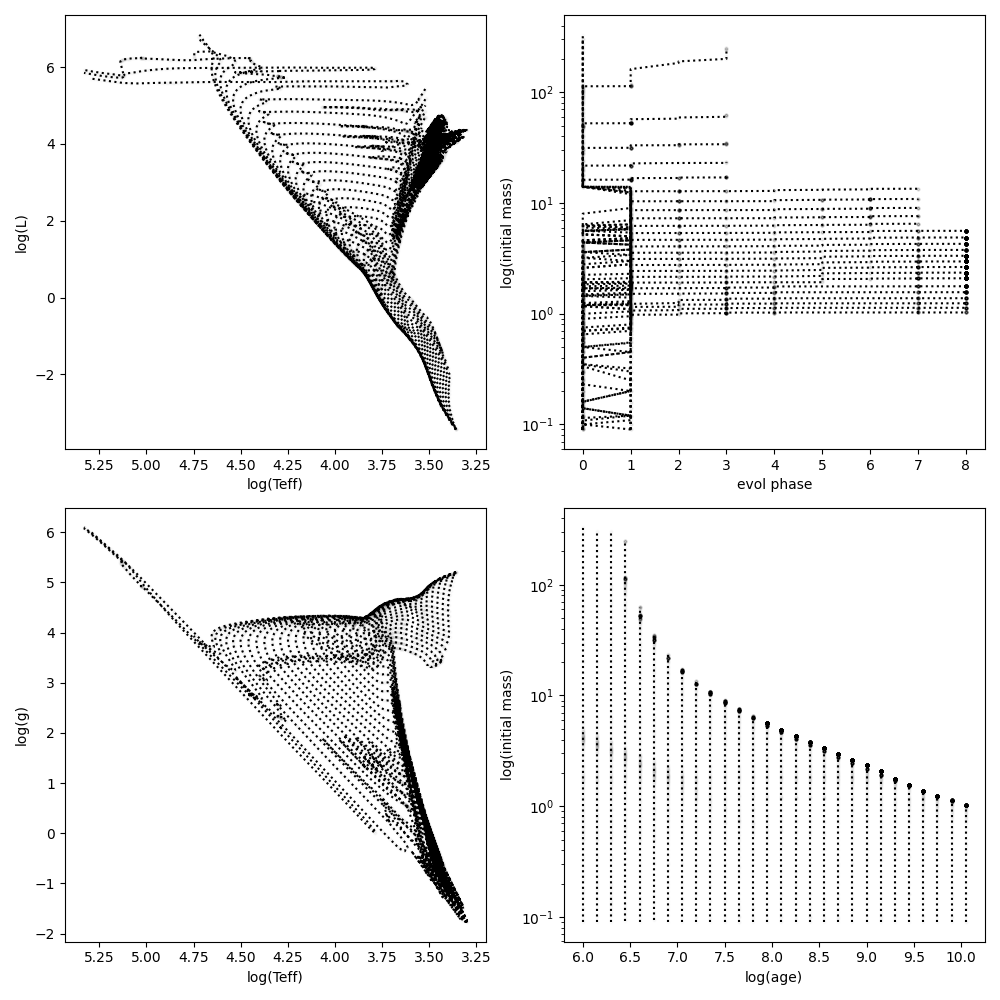
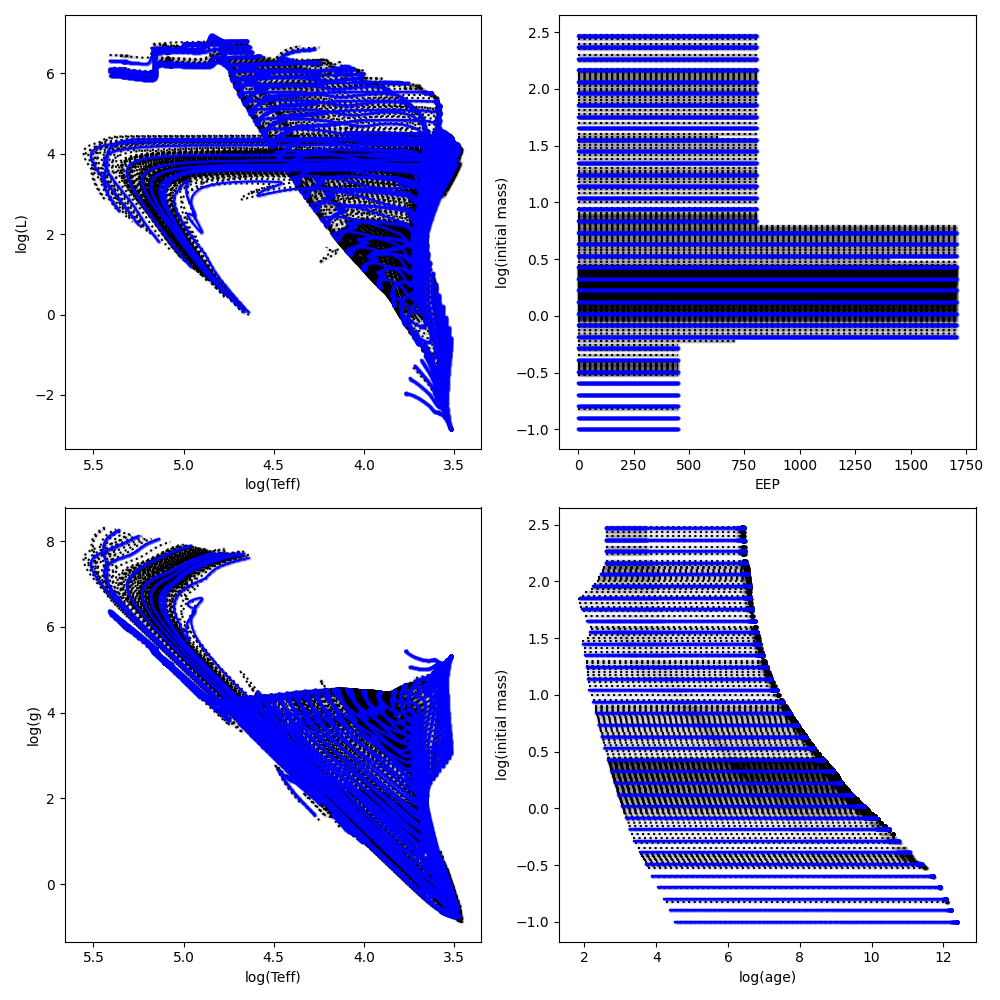
Different views of example MIST evolutionary tracks are shown. The black gives the as provided MIST tracks and the blue gives the interpolated to a uniform mass spacing of log(mass) = 0.1.
Isochrones
Isochrones are derived from evolutionary tracks and give the stellar properties as a function of constant age for different masses. Since stars of different masses have different lifetimes, the mass spacing in an isochrone is variable with age.
Different views of example Padova isochrones is shown. The isochrones were downloaded from the CMD website.